Article · Labour · 4 min read
Union Coverage Lowest in Alberta and Ontario, Highest Gains in P.E.I.
Alberta and Ontario have the lowest union coverage rates of any Canadian province in 2025, and both have bounced back from a low point since — Alberta's bounce three times as large as Ontario's. But being lowest today isn't the same as falling fastest: Prince Edward Island actually posted the largest gain of any province since 1997, while British Columbia, not Alberta or Ontario, saw the steepest decline of the full period.
Alberta and Ontario have the lowest union coverage rates of any Canadian province — the share of employees covered by a collective agreement, whether or not they are union members themselves. In 2025, 23.8% of Alberta employees worked under a collective agreement, and 26.3% of Ontario's did, both well below the national rate of 30.6%. Neither ranking is new. Both provinces have sat near the bottom for decades. What changed is how differently they've moved since hitting bottom.
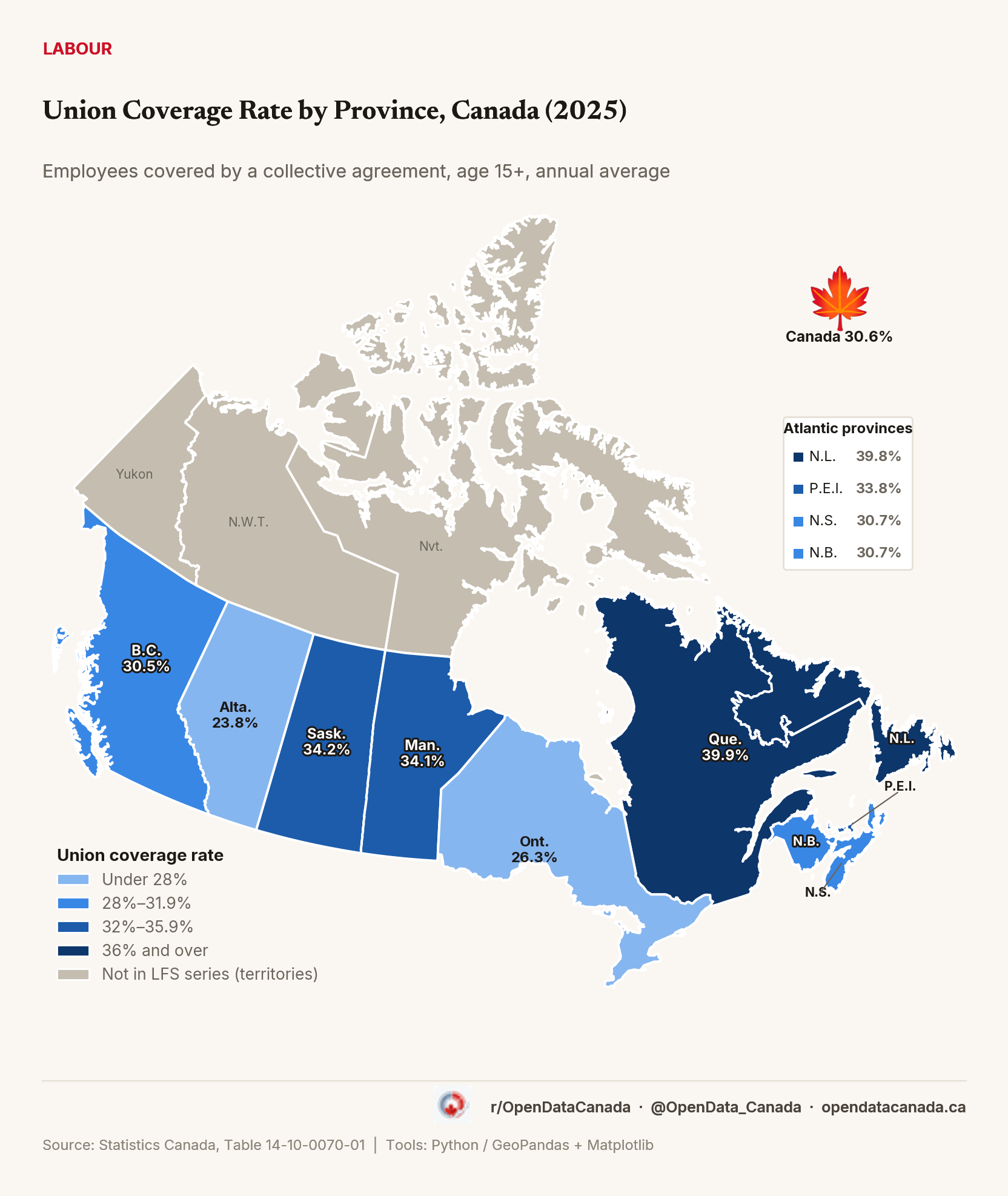
Union coverage rate by province, 2025. Data: Statistics Canada Table 14-10-0070-01.
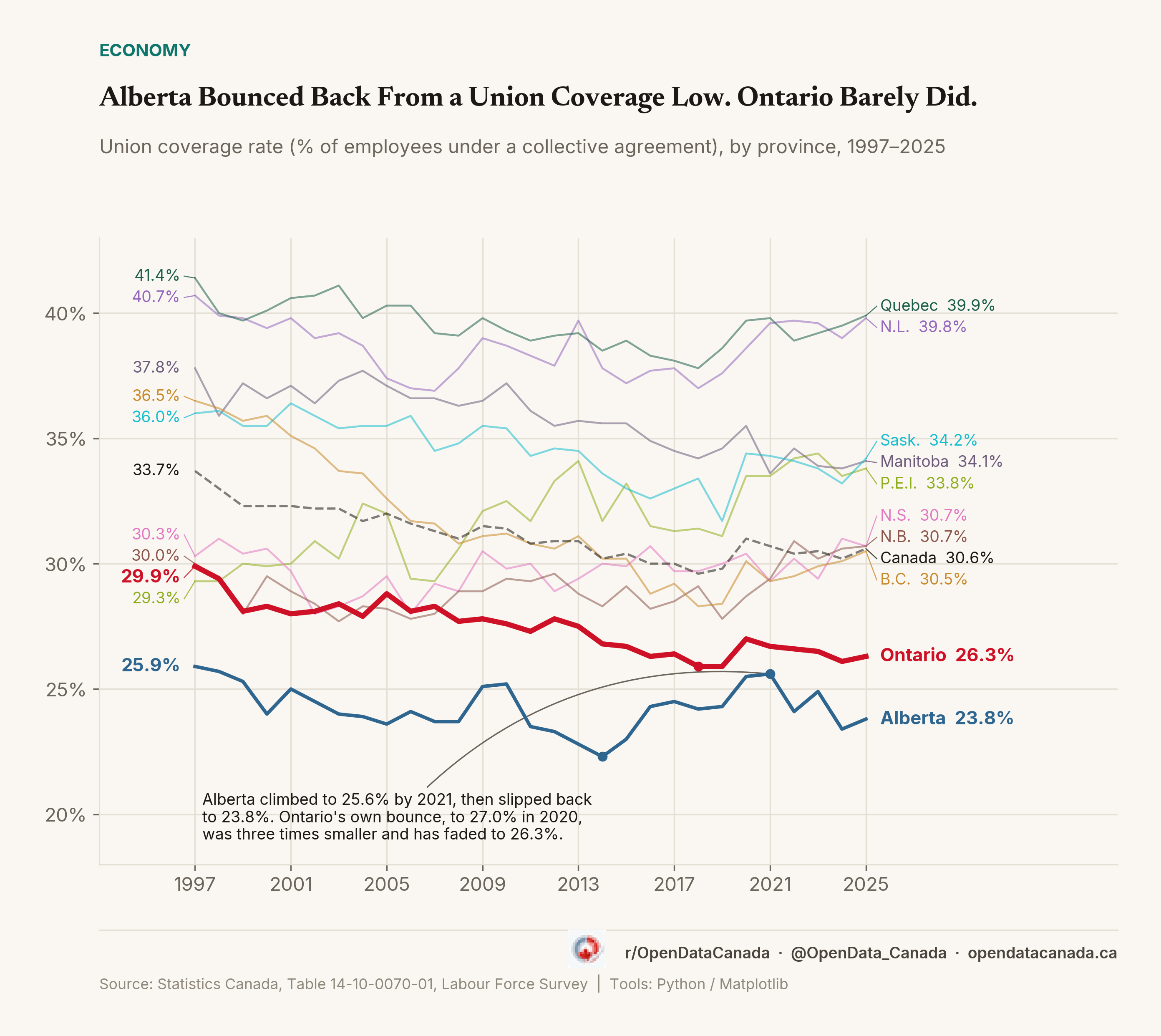
Union coverage rate by province, 1997–2025. Data: Statistics Canada Table 14-10-0070-01.
Both provinces went through a long decline first. Alberta's coverage rate fell from 25.9% in 1997 to a low of 22.3% in 2014. Ontario's fell from 29.9% to a low of 25.9% in 2018, a similar-sized drop. What happened next is where they split. Alberta climbed for seven straight years, reaching 25.6% by 2021, nearly back to its 1997 starting point, before giving more than half of that gain back and sliding to 23.8% by 2025. Ontario never had a comparable climb. It has spent the seven years since its low bouncing in a narrow 25.9% to 27.0% band, never getting much more than a point above where it bottomed out.
Alberta isn't in the middle of an ongoing recovery either. Its own trend has been downward for the last four years too. The difference is scale. Alberta climbed 3.3 points off its low, then gave back 1.8 of them, and still sits 1.5 points above where it bottomed out. Ontario's own bounce, in 2020, added just 1.1 points, and it has given back 0.7 of those, leaving it only 0.4 points above its low. Ontario's smaller recovery is also the more fully erased one.
Nationally, the union coverage rate has hovered around 30% for a decade, essentially flat since the mid-2010s decline leveled off. That stability hides real divergence underneath. Quebec (+2.1 points), B.C. (+2.2) and Saskatchewan (+2.5) have each pulled meaningfully off their own lows, while Ontario, Canada's largest labour market, has mostly gone nowhere. Why Alberta's bounce was three times as large as Ontario's isn't something this data can answer.
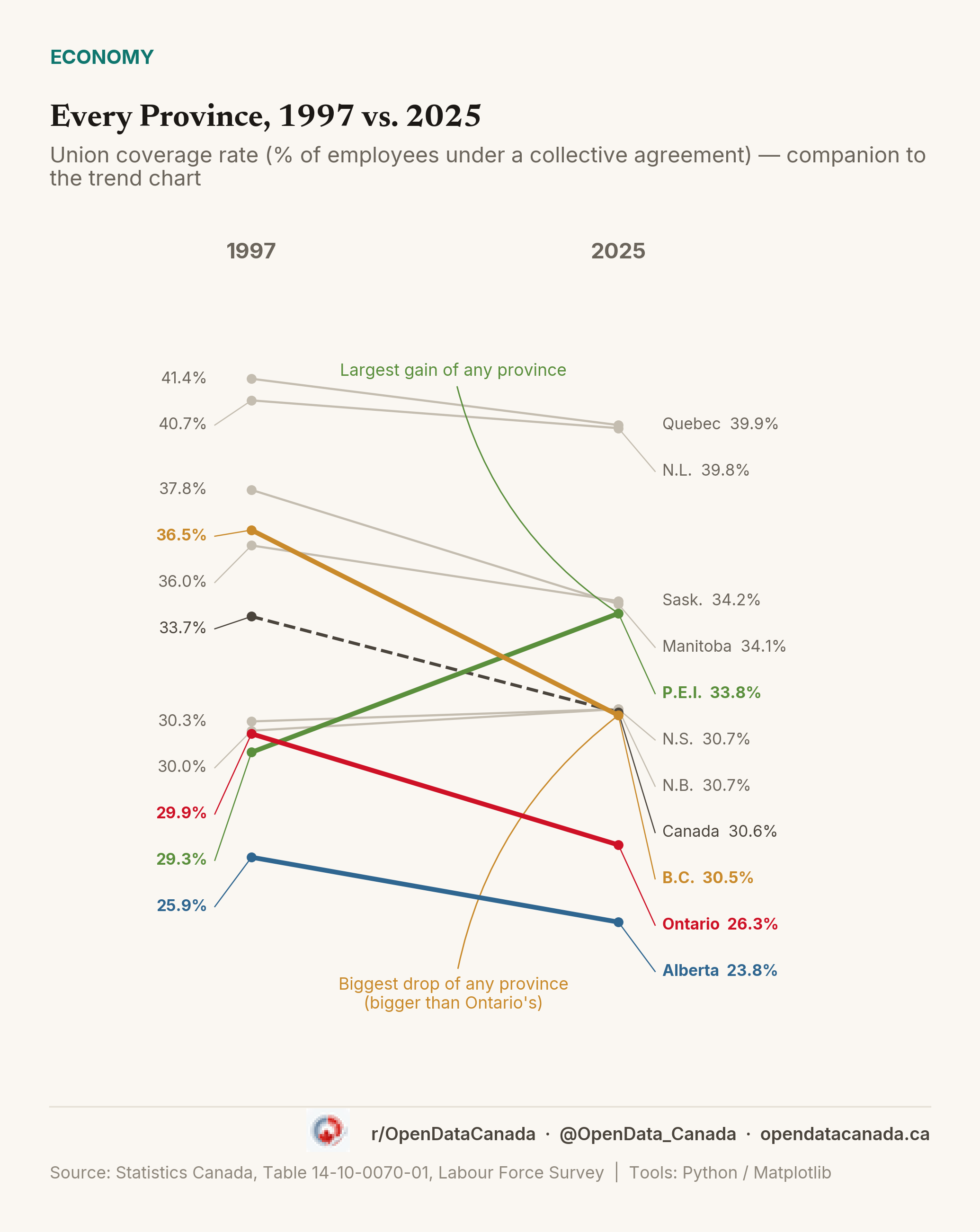
Every province, 1997 vs. 2025. Data: Statistics Canada Table 14-10-0070-01.
Two more numbers complicate the Alberta-and-Ontario story. Prince Edward Island posted the largest gain of any province since 1997, up from 29.3% to 33.8%, a net gain of 4.5 points. New Brunswick (+0.7) and Nova Scotia (+0.4) also edged higher; every other province fell. And the single largest full-period decline belongs to neither Alberta nor Ontario. British Columbia's rate dropped 6.0 points, from 36.5% in 1997 to 30.5% in 2025, a steeper fall than Ontario's 3.6-point decline, even though B.C. still sits well above Ontario in absolute terms. Alberta and Ontario aren't where coverage has eroded fastest. They're where it started low and ended up lowest.
Quebec's 39.9% and Newfoundland and Labrador's 39.8% are the two highest in the country, consistent with a pattern StatCan documents nationally: public-sector employees are covered by a collective agreement at nearly five times the rate of private-sector ones (76.7% versus 15.5% in 2023). What specifically drove Prince Edward Island's rate higher while every other province's fell isn't something the published data explains.
The comparison gets starker across the border. U.S. union membership has been cut roughly in half since 1983, from 20.1% to 9.9% by 2024, a steeper long-run decline than any single Canadian province here. The most recent U.S. numbers complicate the "still losing members" story, though: 2025 data show membership ticked up to 10.0% and union coverage to 11.2%, both slightly above 2024 and, per the Economic Policy Institute, a break from the prior decade's slide. Even with that uptick, U.S. coverage sits at roughly a third of Canada's 30.6% national rate. The two countries aren't just trending differently. They're operating at different scales entirely.
Why Alberta and Ontario are lowest
Neither province's low ranking comes down to self-employment or the size of its public sector. Ontario's self-employed share of total employment (13.5% in 2025) is close to the national average (12.9%), not unusually high. And Ontario's public-sector employment share (22.8% of employees) isn't unusually small either — Canada's is 24.8%. What is unusual: Ontario's public-sector coverage rate is the lowest of the four largest provinces at 71.8%, behind Alberta (73.8%), Canada overall (77.5%), and well behind Quebec (86.2%). Ontario trails on the private side too, at 12.9% versus Canada's 15.1%.
Industry mix explains more of Alberta's gap specifically. Forestry, fishing, mining, and oil and gas — Alberta's defining sector — had a union coverage rate of just 9.1% in 2025, less than half the province's overall rate, consistent with an industry built on non-union contractors and smaller operators rather than large unionized employers.
Labour law history is a likely factor behind both provinces' low, persistent rankings, though it's not something StatCan's data can test directly. Ontario's NDP government introduced card-based union certification in 1992's Bill 40 — a union is certified once enough workers sign membership cards, without a mandatory vote. The incoming PC government's 1995 Bill 7 reversed this, restoring mandatory secret-ballot votes. Ontario's coverage rate has ranked 8th or 9th of the ten provinces in every year of available data since. Subsequent Liberal governments (2003–2018) did not restore card-based certification broadly. Alberta went through a similar cycle later: the NDP government's 2017 Bill 17 introduced card-based certification for unions with support above 65%, and the UCP government's 2019 Bill 2 reversed it two years later, restoring mandatory votes.