Young Canadians are more likely to think AI data centres will hurt the economy
A Nanos poll finds a real generational split on whether AI data centres will hurt the economy, 38% of Canadians 18-34 versus 28% of those 55+. Opposition to government subsidies for building them is a separate story, high at every age, with no meaningful age gap at all.
Published 11 August 2026 · Open Data CanadaSource Nanos Research
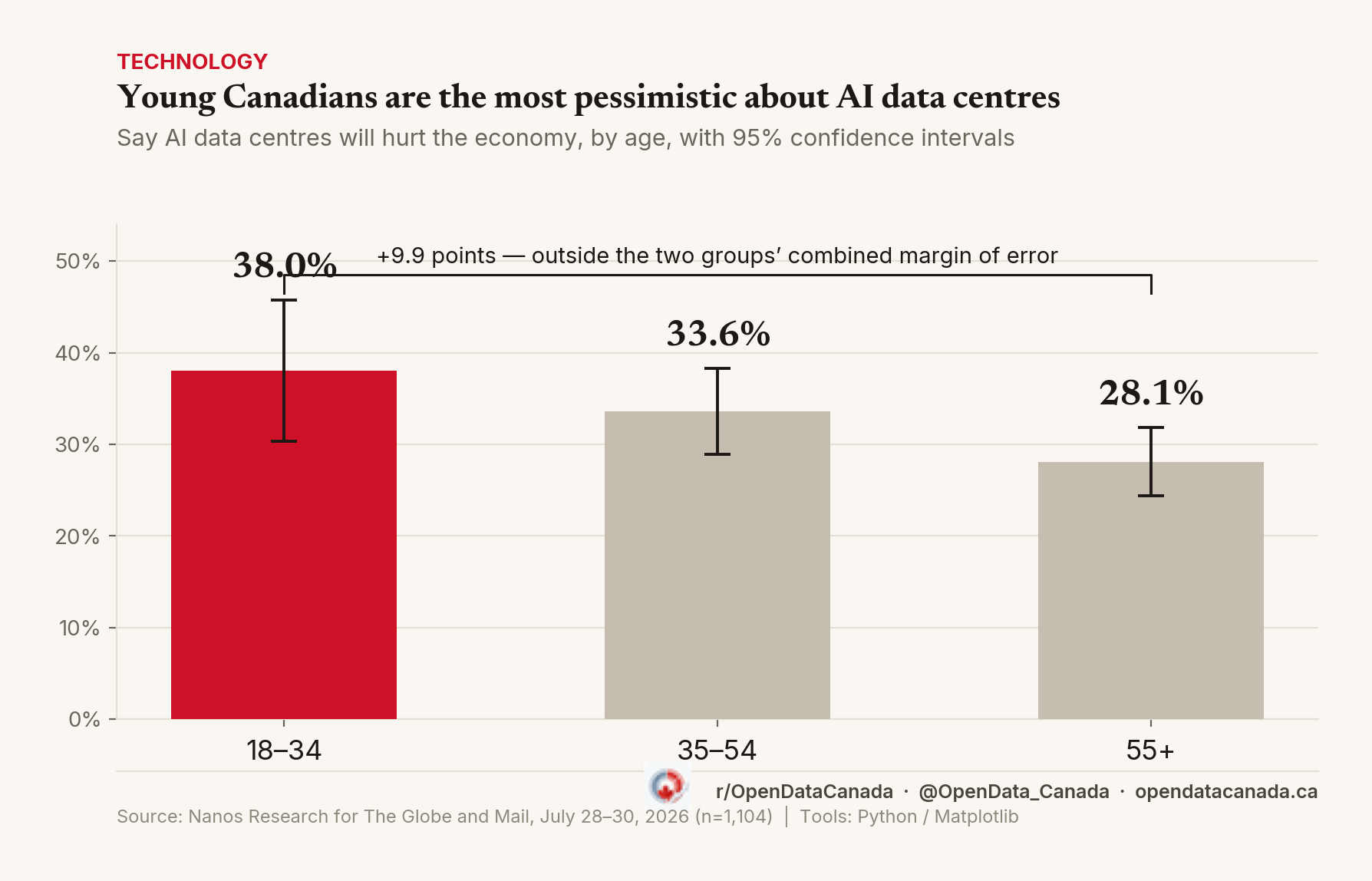
Share of each age group saying AI data centres will hurt the Canadian economy, with 95% confidence intervals. Source: Nanos Research, July 28-30, 2026.
Age subgroups are smaller than the full sample, so their individual margins of error are wider than the survey's topline ±3.0 points, as much as ±7.7 points for the youngest group alone. Comparing the 18-34 and 55+ groups directly, the 9.9-point gap on economic impact sits just outside their combined 95% confidence interval (±8.6 points), so it clears the bar for a real difference. Nanos's own significance testing, described in its report, doesn't flag either age group on this question; the difference it does flag is by gender, and separately, one region stands out on this same question, Quebec residents are less pessimistic than the national average.
A second question in the same survey, on government subsidies for data centre construction, tells a different story.
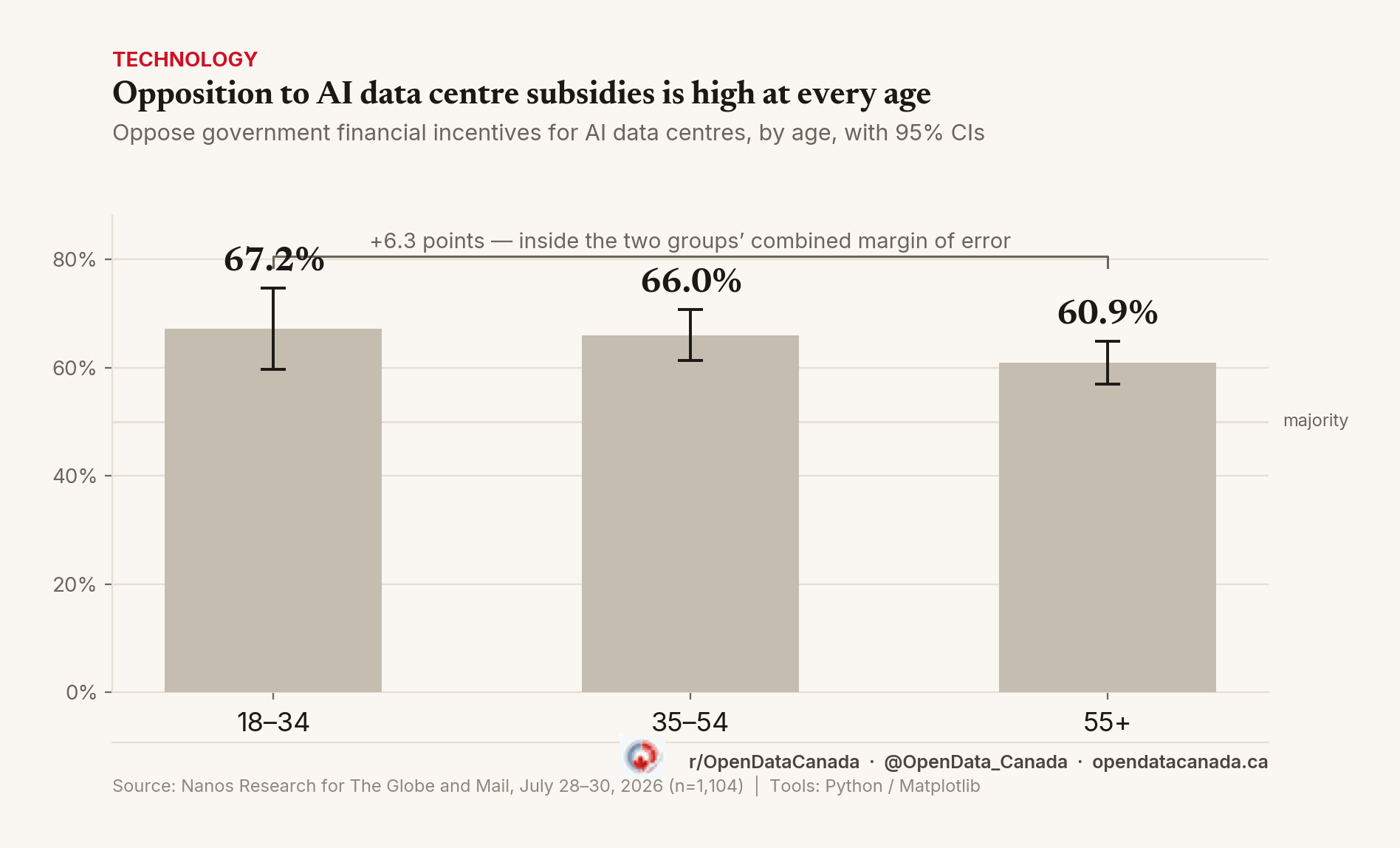
Share of each age group opposing government financial incentives for AI data centres, with 95% confidence intervals. Source: Nanos Research, July 28-30, 2026.
Opposition to subsidies is high in every age group: 67.2% among 18-34, 66.0% among 35-54, 60.9% among 55+. The 6.3-point spread between the youngest and oldest groups is inside their combined margin of error, not distinguishable from chance. This is a near-consensus across generations, not a generational fight.
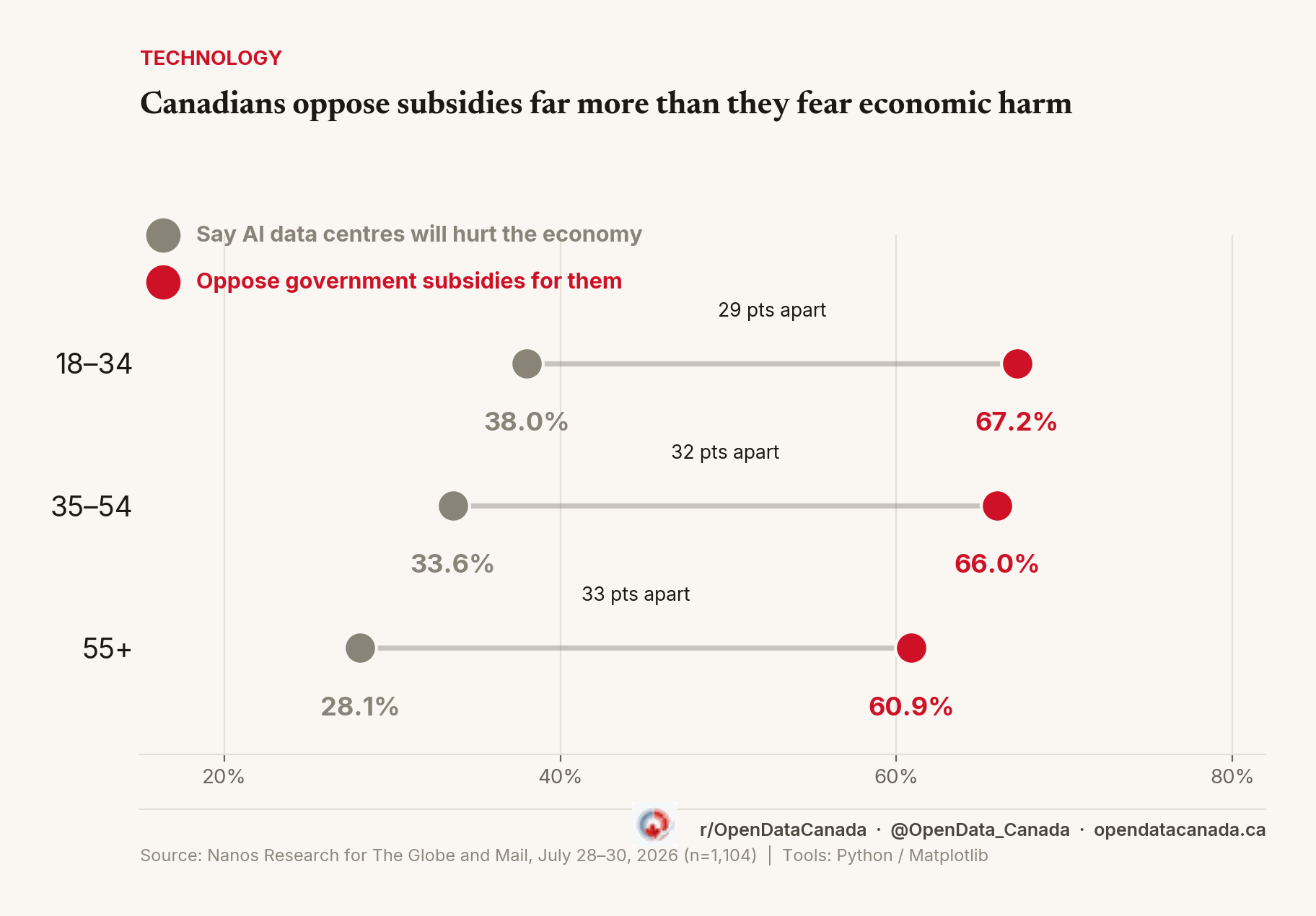
The two questions aren't measuring the same thing. Believing AI data centres will hurt the economy is a minority view at every age, 28% to 38%. Opposing government subsidies for them is a majority view at every age, 61% to 67%, roughly double.
Economic-impact pessimism vs. subsidy opposition, by age. Source: Nanos Research, July 28-30, 2026.
Nanos doesn't publish a joint breakdown of the two questions, but a gap this size implies a large share of subsidy opponents don't actually think the centres will hurt the economy. The opposition looks rooted at least partly in a broader skepticism of subsidizing private industry with public money, not only AI-specific pessimism.
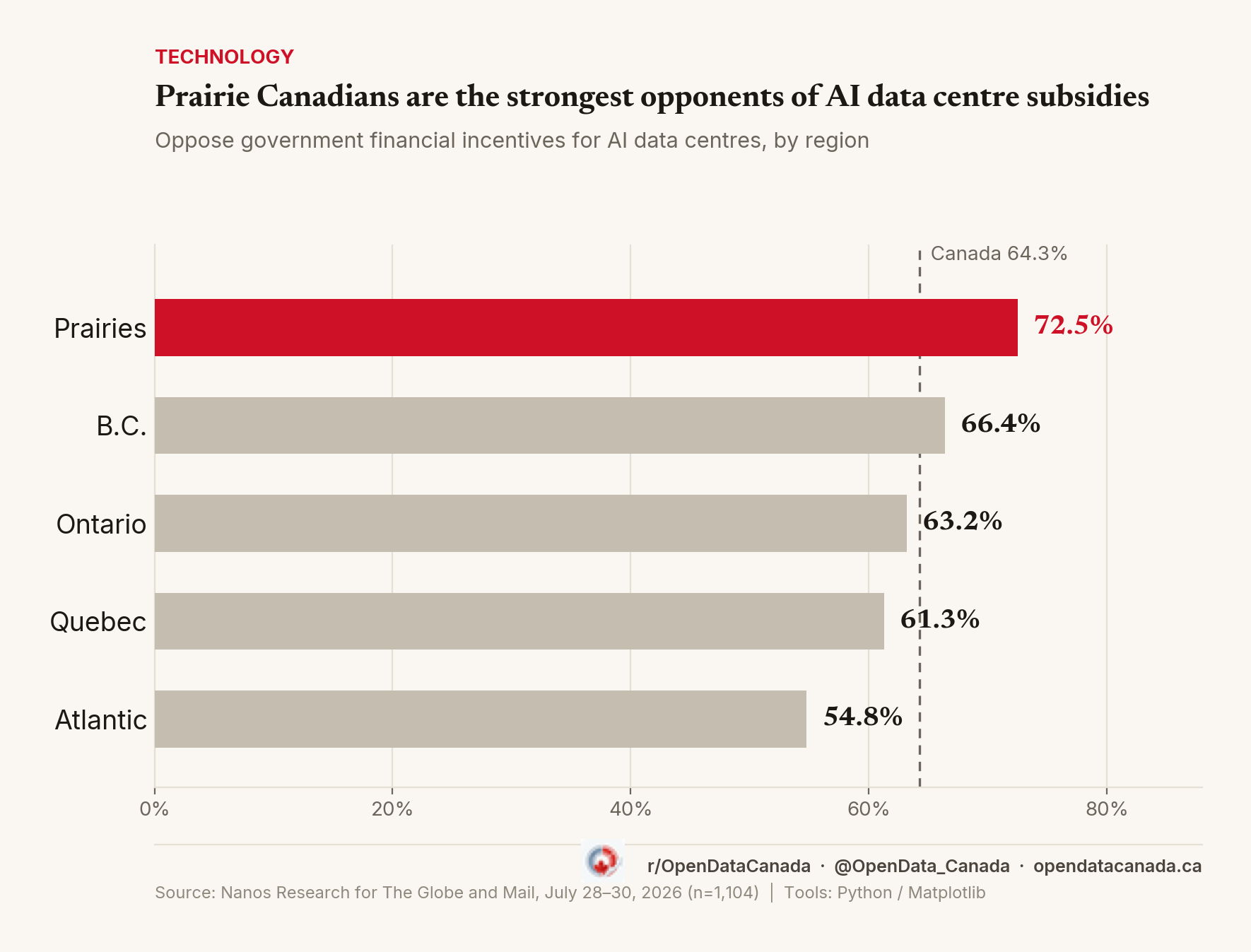
Region, not age, is where Nanos's own significance testing flags the strongest difference on the subsidies question. Prairie residents oppose subsidies at 72.5% combined, and 49.9% oppose outright, both the highest of any region and well above the 64.3% national average.
Share opposing government financial incentives for AI data centres, by region. Source: Nanos Research, July 28-30, 2026.
Random digit dialling (RDD) dual-frame (land- and cell-line) hybrid telephone and online random survey, 1,104 Canadians 18+, fielded July 28-30, 2026, as part of an omnibus survey. Accurate to ±3.0 percentage points, 19 times out of 20; wider for age subgroups.
Age group
Say negative economic impact
Oppose government subsidies
18–34 (n=151)
38.0% ± 7.7pp
67.2% ± 7.5pp
35–54 (n=393)
33.6% ± 4.7pp
66.0% ± 4.7pp
55+ (n=560)
28.1% ± 3.7pp
60.9% ± 4.0pp
Methodology. "Negative economic impact" combines the survey's "negative"/"somewhat negative" response options for the question "do you believe building AI data centres in Canada will have a positive or negative impact on the Canadian economy?" "Oppose government subsidies" combines "oppose" and "somewhat oppose" responses to a separate question on government financial incentives for AI data centre construction. Figures, including age-subgroup sample sizes, are as published by Nanos Research and were not re-weighted or re-estimated by Open Data Canada. Confidence intervals are calculated by Open Data Canada using the standard normal approximation for a proportion (95%, z=1.96) and were not published by Nanos. A gap between two subgroups is treated as statistically distinguishable from chance only when it falls outside the combined 95% confidence interval for the difference between the two proportions; Nanos's own significance testing, described in its report, did not flag either age gap on either question.
The weekly
Three charts and an explainer, every Sunday.
One email a week. New Canadian data charts, the most-discussed thread from r/OpenDataCanada, and the article that expands on whichever chart provoked the best methodology argument. No spam, unsubscribe in one click.