Article · Politics · 5 min read
Carney talks like an economist. Trudeau talked like an advocate.
Two Liberal prime ministers, the same job, sharply different vocabularies. We counted every word in their House of Commons speeches. Mark Carney governs in the language of budgets and the economy; Justin Trudeau spoke in the language of care and climate. It shows in the words each man reaches for most.
Same party, same office, and yet the two most recent Liberal prime ministers do not sound alike. We took every speech Mark Carney has given in the House of Commons since he took office, and every speech Justin Trudeau gave in his final two years, stripped out the filler words, and counted what was left. Measured by how often each word shows up per 1,000 content words, the two men reach for different vocabularies.
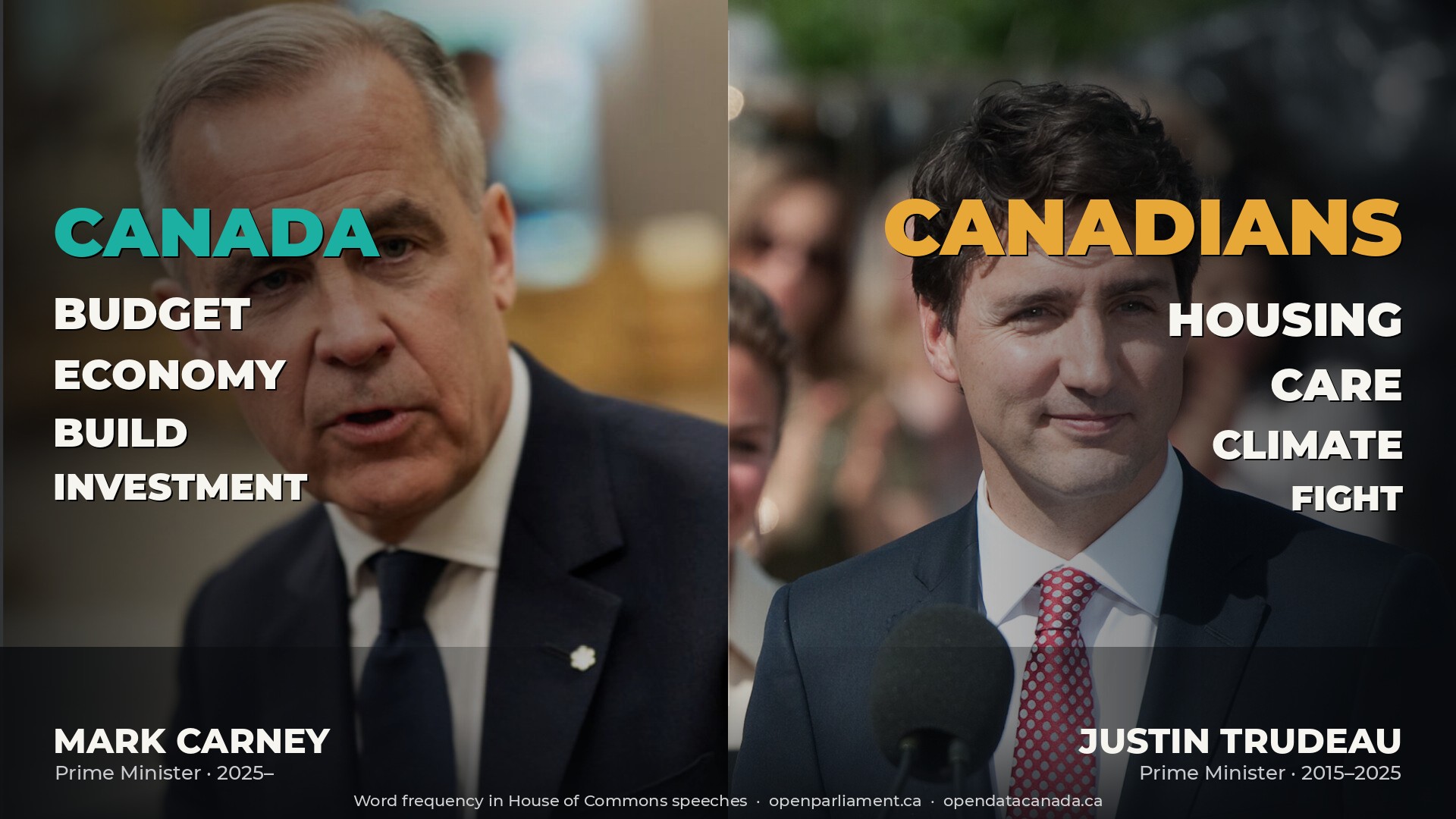
The clearest signal is the word each man uses most. Trudeau's most common content word was "Canadians"; he spoke to people. Carney's is "Canada," with "budget" and "economy" close behind; he speaks about the country and its finances.
What Carney talks about
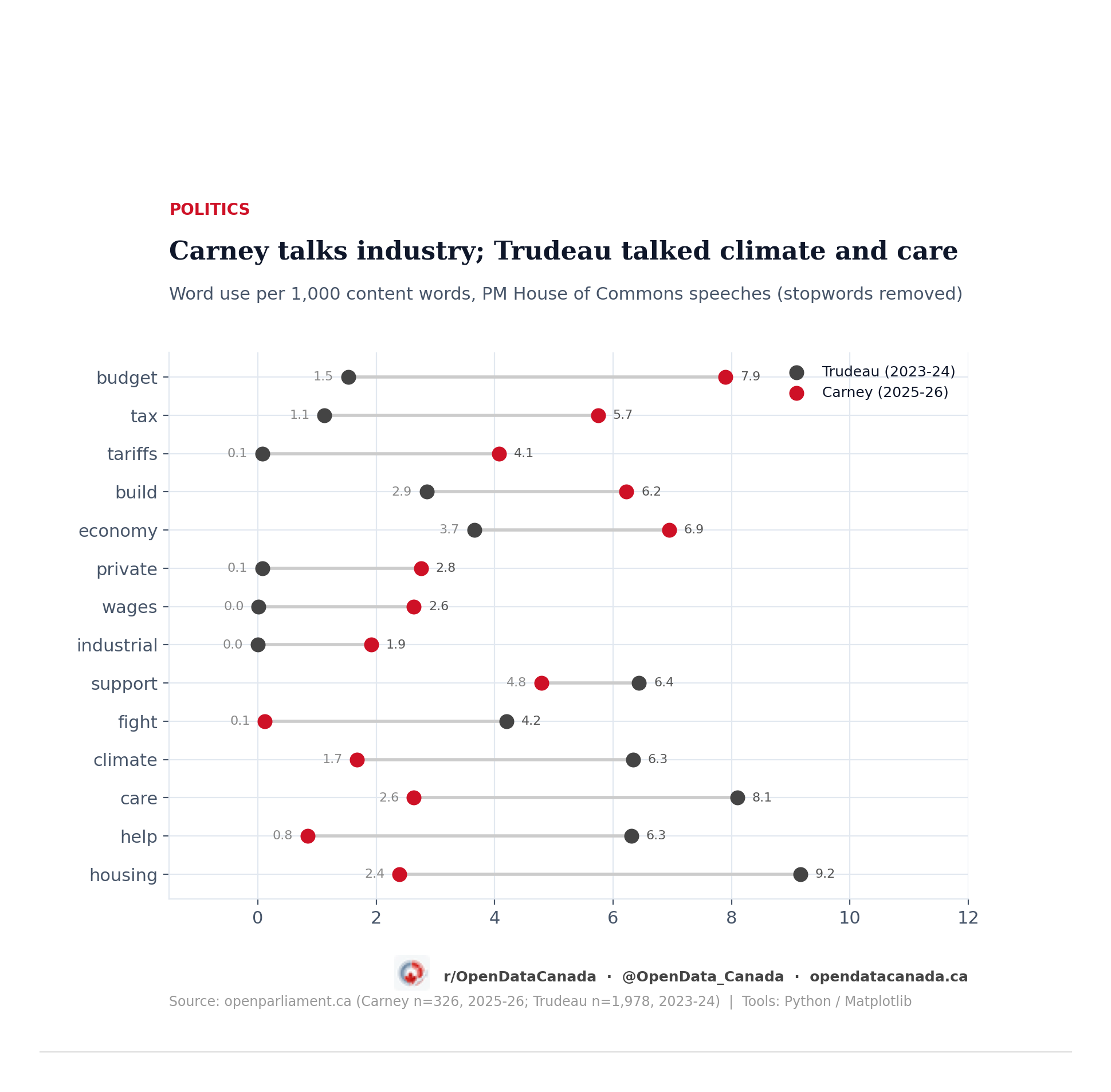
Carney's vocabulary comes straight from his old job. Budget (7.9 per 1,000 words), economy (6.9), build (6.2), investment (4.8) and tax (5.7) all run well ahead of Trudeau's rates. Words that barely appear in Trudeau's speeches, such as private (sector), wages and industrial, turn up regularly in Carney's. By the numbers, he is the country's first central-banker prime minister.
What Trudeau talked about
Trudeau used housing nearly four times as often as Carney does, and care, climate and help several times more. Fight, a word Carney has almost never used, was among his signatures. This is the vocabulary of an advocate making a social-policy case, and of a communicator focused on the opposition, who named "Conservatives" over and over. Exact rates for every word are in the chart below.
The words that set them apart
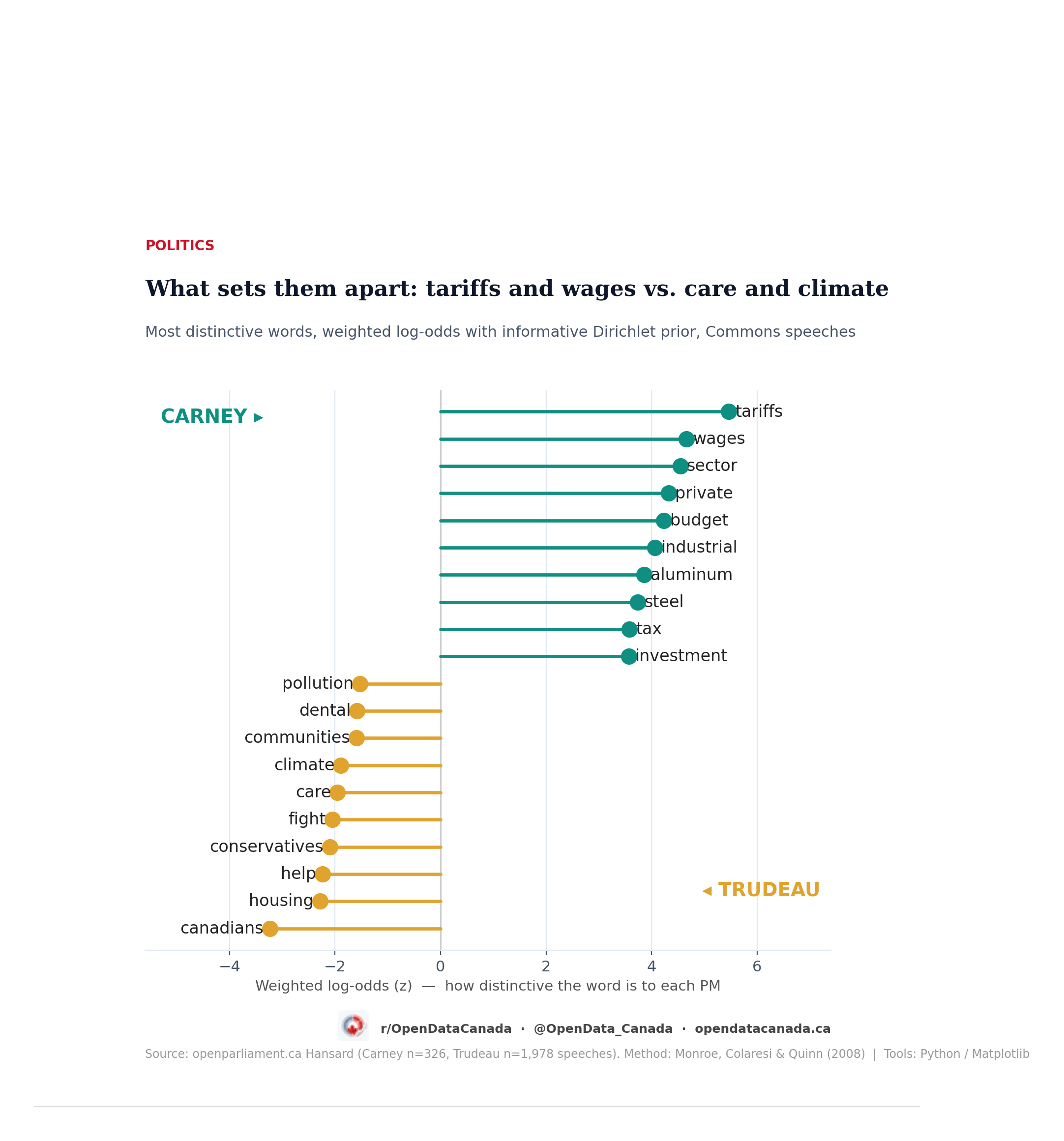
Raw frequency has a weakness. The most common words can drown out the interesting ones, and both men say "Canada" and "government" constantly, so a plain tally can tell you more about parliamentary boilerplate than about either prime minister. To get around that, we ran a second test: a weighted log-odds measure, the method political scientists use to find the words that distinguish one group of speakers from another. Rather than counting how often a word appears, it measures how distinctive the word is to one speaker. It also adjusts for the fact that Carney's record so far is about a tenth the size of Trudeau's, so a word he happens to use once or twice is not mistaken for a signature.
The second test sharpens the picture rather than redrawing it. The words most distinctive to Carney belong to trade and the balance sheet: tariffs, wages, sector, private, industrial, aluminum, steel, budget, tax. The words most distinctive to Trudeau belong to the campaign and the social safety net: Canadians, housing, help, fight, care, climate, dental, pollution, along with Conservatives, the opponent he named repeatedly.